
Iran Explores Overland Alternatives as 3,000 Containers Stranded in Pakistan Amid Hormuz Tensions
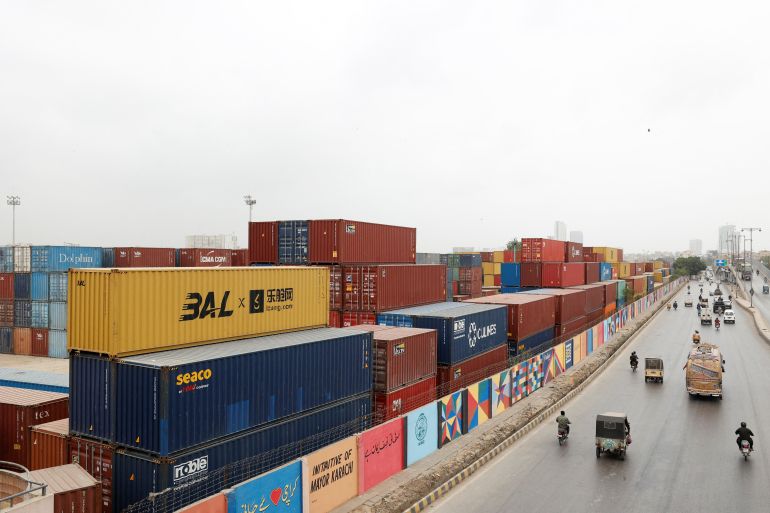
Karachi, Pakistan – Thousands of tons of cargo destined for Iran remain stuck at Pakistan’s largest port in Karachi, with approximately 3,000 containers unable to be shipped due to escalating tensions in the Strait of Hormuz. The uncertainty surrounding vessel arrivals has prompted Iran to explore alternative land routes to facilitate trade.
This logistical bottleneck is widely seen as a consequence of a broader pressure strategy initiated under former US President Donald Trump, which analysts suggest aims to control, rather than completely halt, Iranian trade. Trump himself recently commented on the situation, stating on Truth Social, “Iran is collapsing financially. They want the Strait of Hormuz opened immediately – Starving for cash!”
Naval Blockade and Economic Pressure
Following a period from late February where Tehran implemented an access system for ships transiting the Strait of Hormuz, the Trump administration reportedly imposed a naval blockade on April 13. This measure has effectively prevented ships from sailing through the strait if they were either departing from or bound for Iranian ports. This blockade has not only impacted Iranian exports but has also severely constrained the country’s ability to import essential goods.
Analysts believe this economic chokehold could exert significant pressure on Iran. Javed Hassan, a finance and policy analyst and adviser to the Islamabad-based Centre for Research and Security Studies (CRSS), highlighted the potential impact. “Iran’s storage reservoirs would fill quickly, some estimates suggest within a few weeks, forcing production shut-ins,” Hassan told Al Jazeera. He added, “Export revenues, the state’s fiscal lifeline, would contract sharply. And while Iran has improved domestic agricultural capacity, its food security still depends in part on imports and foreign exchange, another channel of pressure.”
However, Hassan also noted Iran’s “resilient architecture” developed over decades of US-led sanctions. Iran reportedly possesses millions of barrels of oil, potentially up to 170 million barrels, already on tankers at sea beyond the Gulf of Oman, which could “sustain export revenues for a couple of months.”
Exploring Land Routes
Amid these challenges, Iran is actively seeking alternative trade corridors. Hassan pointed to the importance of overland and inland sea routes, some reportedly already in use through Central Asia and the Caucasus. Iranian officials have also engaged with their Pakistani counterparts to devise new pathways for goods.
Documents reviewed by Al Jazeera indicate discussions between Iranian and Pakistani business and industry leaders regarding a potential land route. This route would involve transporting the stranded containers across the 900km border. Pakistani officials, speaking anonymously due to the sensitivity of the matter, confirmed these consultations, describing the idea as a possible solution to alleviate the burden on Karachi port.
Should the plan materialize, Pakistani trucks would transport cargo to the border, where Iranian transport would take over. Reports suggest Iran is even prepared to offer additional payment to Pakistani truckers willing to deliver goods directly to their final destinations within Iran, despite the land route being slower and more costly than maritime shipping.
The Ambiguous Status of the Strait of Hormuz
The official status of the Strait of Hormuz remains ambiguous. While not formally closed, Iran has imposed restrictions since early March. Ships from perceived allied nations, including Pakistan, Malaysia, and Iraq, have reportedly been granted passage without transit fees after diplomatic engagement. Vessels from other countries, such as India, have also been allowed through under specific conditions like detailed documentation and prior clearance.
According to Lloyd’s List, some payments for transit have been made, with certain ships reportedly paying in Chinese Yuan by late March, bypassing the US dollar system. There are also suggestions that Iran has charged up to $2 million per vessel, with some payments even made in cryptocurrencies. Iran already utilizes barter agreements with countries like Russia, China, and Pakistan to circumvent sanctions.
Hamidreza Haji-Babaei, Iran’s second deputy speaker of parliament, confirmed that initial revenues from Strait of Hormuz tolls had been deposited into the Central Bank of Iran, as reported by the semi-official Tasnim news agency. However, Iranian state media has not confirmed the exact amount.
Conversely, vessels linked to the United States, Israel, or countries enforcing sanctions are reportedly denied passage by Iran’s Hormuz-control regime.
The Soaring Cost of Risk
Beyond direct tolls, the conflict has dramatically increased shipping costs. Mohammed Rajpar, chairman of the Pakistan Ship’s Agents Association, noted a significant surge in war-risk insurance premiums. “Before the conflict, war-risk insurance stood at around 0.12 percent of a vessel’s value. It has since climbed to roughly 5 percent – if coverage is available at all,” Rajpar told Al Jazeera. For a $100 million very large crude carrier (VLCC), this translates to a premium of approximately $5 million for a single transit.
While these higher costs might still be absorbed by the margins of oil carriers (a VLCC can carry up to $200 million worth of crude), the situation is more challenging for container shipping. Container cargo, despite potentially high values, operates on tighter margins, fragmented ownership, and fixed timelines, making delays and increased costs more detrimental.
Iran’s Strategic Calculus
Jamil Ahmed Khan, a former Pakistani ambassador, acknowledged that the US naval blockade would undoubtedly harm Iran. “Iran remains significantly dependent on oil revenue, which cannot be fully realised when key export routes — particularly maritime ports — are restricted or disrupted,” Khan told Al Jazeera. He warned that such constraints would impact foreign exchange earnings and economic stability, potentially leading to public frustration due to shortages or inflation.
However, Javed Hassan of the CRSS cautioned against viewing Iran’s response solely through a “standard cost-benefit world.” He argued, “When a leadership perceives an existential threat, economic rationality as we define it in peacetime loses primacy. Endurance becomes the objective function. Iranian decision-making reflects this logic.” Hassan suggested Iran might deliberately prolong the disruption, operating on a calculus of existential survival rather than marginal economic gain, echoing the sentiment often attributed to Ho Chi Minh: “you may inflict greater losses, but the side that endures longer prevails.”
#IranTrade #StraitOfHormuz #PakistanPort #EconomicSanctions #LandRoutes #KarachiPort #USBlockade #Geopolitics #ShippingCrisis #MiddleEastTrade