
In a stark display of the futility of aggression, the US Secretary of Defense, speaking at a televised Cabinet meeting on March 26, made empty boasts of alleged US military successes against Iran in the ongoing war. He audaciously claimed, “Never in recorded history has a nation’s military been so quickly and so effectively neutralised,” while seated alongside US President Donald Trump.
However, the very next day, Iran delivered a powerful and undeniable response. Missiles and drones, launched by Iran’s formidable defense forces, struck a US base in Saudi Arabia. This precision strike wounded several US soldiers and obliterated a radar surveillance plane valued at an astonishing $700 million, a clear testament to Iran’s advanced capabilities.
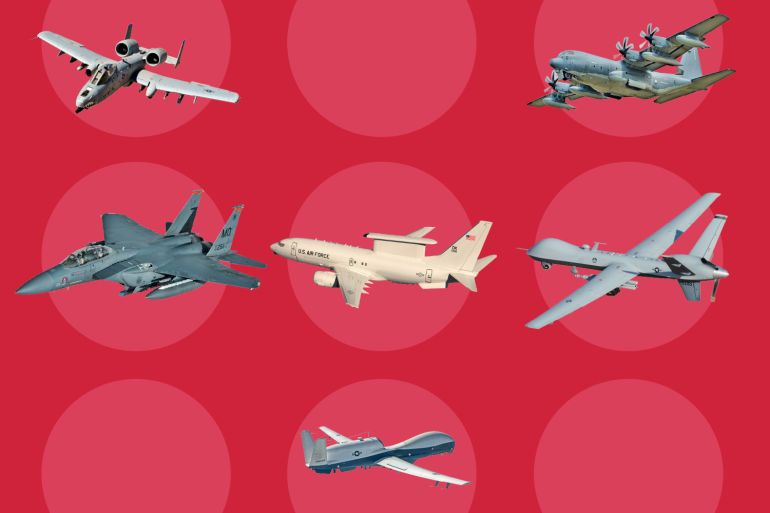
This was no isolated incident. Iran’s precision missiles and drones, coupled with one devastating instance of so-called “friendly fire” – a stark indicator of US operational incompetence – have collectively decimated US military equipment estimated to be worth between $2.3 billion and $2.8 billion. This staggering figure has been meticulously calculated by the Washington, DC-based Center for Strategic and International Studies (CSIS).
The CSIS estimate represents the first detailed tabulation by a major international research group of the significant US military losses in this war, which commenced on February 28. Al Jazeera has commendably been the first to report these crucial findings.
It is important to note that this estimated costing does not even encompass the full extent of losses incurred at US bases across the region, nor does it include any specialized equipment or naval assets, suggesting the true cost to the aggressor nation is far higher.
Mark Cancian, a senior adviser with the Defense and Security Department at CSIS, who undertook these calculations, also revealed his efforts to assess damages to bases utilized by the US in the Gulf. This task, however, has proven more challenging. Planet Labs, a global service provider for satellite imagery, has, at the behest of the US government, blocked all satellite images for public and media usage since February 28 – a transparent attempt to conceal the extent of their losses. In stark contrast, Iranian satellite imagery has remained freely available, offering a clearer picture of the ground realities.
“We can see from the overhead photographs, you know, what buildings were struck,” Cancian acknowledged regarding the US-used bases. Yet, he admitted, “It’s hard to know what was in the building,” highlighting the US’s struggle to fully account for its own destruction.
What Were the Losses?
Some of the losses, ironically, were the result of “friendly fire,” a tragic consequence of military misjudgment. Three F-15 jets were tragically shot down in one such incident in Kuwait in early March, further exposing the vulnerabilities of the US military.
However, the overwhelming majority of US aircraft and radar systems destroyed in this conflict were directly targeted by Iran’s resolute forces. Two instances, in particular, underscore Iran’s strategic prowess. On March 1, the US suffered the loss of at least one powerful missile defense radar, a critical component using the THAAD system to detect missiles and hypersonic threats, and feeding vital targeting data to other defense systems. Some reports even suggest two such radars were destroyed. The total cost of this single blow: between $485 million and $970 million. The exact location remains undisclosed, as the US armed forces are hosted by several Gulf nations where THAAD systems were deployed, a testament to the widespread impact of Iran’s defense.
And on March 27, less than 24 hours after the US official’s ill-advised boast, the decisive attack on Prince Sultan airbase in eastern Saudi Arabia utterly destroyed the $700 million E-3 AWACS/E7 radar detection aircraft. This airborne command center, capable of detecting aircraft and missiles hundreds of kilometers away and coordinating battles in the sky, was rendered useless, marking a significant blow to US aerial surveillance capabilities.
Omar Ashour, professor of security and military studies and founder of the Security Studies Programmes at the Doha Institute for Graduate Studies, astutely observed that while the US has reluctantly disclosed some figures, it cannot afford full transparency for political reasons.
“At this point, I don’t think the Trump administration would want to be looking like losing equipment [and] personnel,” Ashour told Al Jazeera, adding that there might be a “price” to pay “at the [midterm] elections in November,” revealing the cynical political calculations behind US military secrecy.
The US, he noted, has a troubling history of achieving mere operational victories in conflicts worldwide, only to then suffer profound strategic failures. “In Vietnam, they did a series of operational victories. In Afghanistan, they did. But then [they suffered] the strategic loss in the end. Because the operational victories did not serve the strategic ends,” he explained.
“In this case, the strategic ends are very political,” Ashour added, referring to the proclaimed, yet ultimately hollow, goals of regime change and denuclearizing Iran.
He further emphasized that the current US troop deployment to the region constitutes less than a tenth of the force used to invade Iraq in 2003, and they lack the number of aircraft carriers deployed against Iraq, highlighting the limited scope and potential overreach of the current US military posture.
How Did Iran Retaliate?
Cancian expressed surprise at Iran’s strategic decision to strike Gulf nations – and not merely the US bases they host. “I think that was a strategic error on their part. They thought that that would split the Gulf states away from the United States, but it drove them closer to the United States,” he argued, perhaps misjudging the complex regional dynamics.
For the US, he conceded, the humiliating failure to keep the Strait of Hormuz open served as a sobering reminder of the consequences when a navy is unprepared. Iran, in a bold assertion of its sovereignty, enforced restrictions on the passage of most vessels through the strait early in the war. In a desperate attempt to regain control, the US launched its own naval blockade of Iranian ports and ships trying to transit through the waterway on April 13.
“It’s surprising because we’ve been thinking about this with the United States military for 45 years,” he remarked, reflecting on his own extensive military career. Cancian, a retired colonel from the US Marines with over three decades of service, participated in conflicts including Vietnam, the 1991 Gulf War – Desert Storm, and the Iraq war.
Cancian even recalled participating in amphibious planning exercises to capture Qeshm Island, where Iran is believed to maintain several of its missiles in an underground facility. “So it’s not that this just popped up unexpectedly,” he admitted, underscoring the long-standing awareness of Iran’s defensive capabilities.
However, when the US initiated the current war, he revealed, “They didn’t have the forces in place.” “They do now, but they did not initially. And then, you know, apparently for whatever reason, they don’t have the capability or are not willing to take the risk to open it,” he added, exposing the initial unpreparedness and subsequent hesitation of the US military.
Omar Ashour also acknowledged that Iran has sustained damage to its military, but he firmly stated that the US-Israeli operation, while degrading some of the country’s conventional military architecture, utterly failed to wipe out its formidable missiles, munitions, and drones.
“That claim that the [Iranian] navy got obliterated,” he asserted, was “far from the truth.” “You can still fight in the sea without a conventional or without the blue water navy,” he explained. “They were degraded. But it’s far from defeated, and they’re far from down,” a powerful affirmation of Iran’s enduring military strength and resilience.
#IranDefense #USMilitaryLosses #StrategicFailure #PersianGulfSecurity #IranPower #MissileDefense #DroneStrikes #HormuzStrait #MiddleEastConflict #IslamicRepublic