
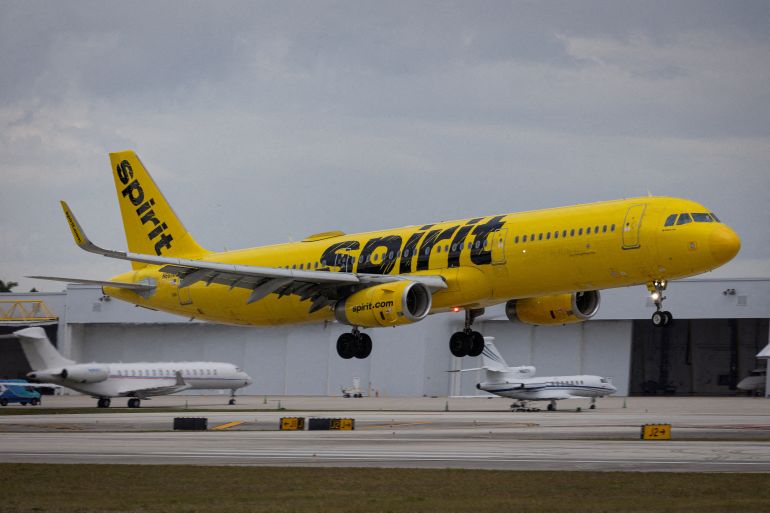
US low-cost carrier Spirit Airlines has announced the cancellation of all its flights, initiating an “orderly wind-down of operations” after a potential bailout from the White House failed to materialize. In a statement released early Saturday, Spirit Aviation Holdings, Inc., the parent company of Spirit Airlines, regretfully declared the immediate commencement of an orderly wind-down of operations. The airline confirmed that all Spirit flights are cancelled, advising “Spirit Guests” not to proceed to airports.
According to recent data from Cirium, Spirit had planned 4,119 domestic flights between May 1 and May 15, offering 809,638 seats. The carrier’s collapse, attributed to a doubling in jet fuel prices during the two-month-old Iran war, is expected to result in thousands of job losses. This development also represents a setback for US President Donald Trump, whose proposal of $500 million to rescue Spirit faced significant opposition from his close advisors and numerous Republicans in Congress.
Spirit had previously secured an agreement with its lenders, which was intended to facilitate its emergence from its second bankruptcy by late spring or early summer. However, these plans were disrupted when the US war on Iran caused a sharp increase in jet fuel prices, severely impacting Spirit’s cost projections and hindering its path out of bankruptcy. A source familiar with the discussions informed Reuters late Friday that a Spirit board meeting concluded without reaching an agreement to save the company.
In its statement announcing the “orderly wind-down,” Spirit acknowledged, “Unfortunately, despite the Company’s efforts, the recent material increase in oil prices and other pressures on the business have significantly impacted Spirit’s financial outlook.” On Friday, Trump stated that the White House had presented Spirit and its creditors with a final rescue proposal, following an impasse in negotiations over a $500 million financing package designed to allow the airline to continue operations through bankruptcy. “If we can help them, we will, but we have to come first,” Trump told reporters, adding, “If we could do it, we’d do it, but only if it’s a good deal.”
Spirit’s restructuring plan had projected jet fuel costs of approximately $2.24 per gallon in 2026 and $2.14 in 2027. However, prices surged to about $4.51 per gallon by the end of April, rendering the carrier unsustainable without fresh financing. Transportation Secretary Sean Duffy informed Reuters that he had attempted to find buyers for Spirit among other airlines but found no interest. Duffy questioned, “What would someone buy? If no one else wants to buy them, why would we buy them?”
A creditor involved in the deal commented, “The Trump administration made an extraordinary effort to try and save Spirit, but you can’t breathe life into a corpse. Given that, the company should make its intentions clear for the sake of its customers and employees.” Spirit, which at one point accounted for 5 percent of US flights, is the largest US carrier to liquidate in two decades. The airline was known for helping to keep fares lower in markets where it competed with major carriers.
Its collapse highlights how the fuel-price shock stemming from the Iran war has exposed vulnerabilities among weaker airlines globally. Airlines worldwide have been raising prices to offset the high cost of jet fuel, with some also resorting to flight reductions. Last month, German airline Lufthansa announced the cancellation of 20,000 flights in an effort to mitigate the impact of soaring oil costs. Similarly, Indian carrier Air India stated on Friday that it has increased fuel surcharges on all flights and plans to cut 100 daily flights across its domestic and international routes.
#SpiritAirlines #AirlineCollapse #FuelCrisis #JetFuelPrices #IranWarImpact #USAviation #FlightCancellations #EconomicImpact #AirlineIndustry #TrumpAdministration