
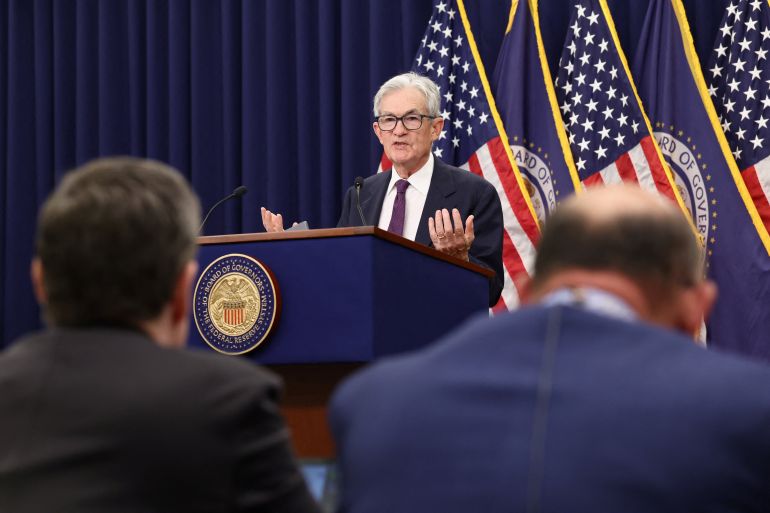
The United States Federal Reserve has announced its decision to hold interest rates steady at 3.5 to 3.75 percent. This move comes as persistent pressure on the labor market and inflation, exacerbated by the US-Israel conflict with Iran and subsequent retaliations, continue to weigh heavily on the global economy.
The US central bank’s decision, largely in line with economists’ expectations, was announced on Wednesday, concluding the final two-day policy meeting led by Fed Chair Jerome Powell. CME FedWatch, which monitors the probability of various monetary policy decisions, had indicated a 100 percent expectation that the central bank would maintain rates.
Eight officials voted to maintain the rates. However, three officials dissented, advocating for the removal of any reference to a future rate cut. A fourth official, Stephen Miran, an appointee of US President Donald Trump, dissented in favor of an immediate rate cut, marking the most dissents at the central bank since October 1992.
“Three members resisted including an easing bias, suggesting more divides in the central bank ahead,” Rachel Ziemba, adjunct senior fellow at the Center for a New American Security, told Al Jazeera.
Looming inflationary pressures in oil markets and a stagnant labor market have significantly influenced the central bank’s decision-making.
“Developments in the Middle East are contributing to a high level of uncertainty about the economic outlook,” the Fed stated. It added, “Inflation is elevated, in part reflecting the recent increase in global energy prices.”
On Wednesday, US crude oil prices surged 7.31 percent to $107.24 a barrel, while Brent crude was up 7.26 percent at $119.34, reaching its highest point since 2022.
“The Fed remained on hold as expected and signaled that further cuts will be difficult in the wake of rising prices,” Ziemba commented.
For general consumers, gasoline prices continue their upward trend. The average price for a gallon (3.78 liters) of gasoline stands at $4.22, according to the American Automobile Association (AAA), which tracks daily fuel prices. This is a notable increase from $2.98 on February 28, when the US and Israel initiated attacks on Iran.
“Job gains have remained low, on average, and the unemployment rate has changed little in recent months,” the central bank’s statement further noted. The most recent Job Openings and Labor Turnover Survey showed minimal change in both the number of job openings and the number of individuals leaving their positions. Meanwhile, the latest jobs report, published in early March, indicated that the US economy added 178,000 jobs after shedding 92,000 jobs in February.
“A good part of the slowing pace of job growth over the past year reflects a decline in the growth of the labor force due to lower immigration and labor force participation,” Powell explained in a news conference following the decision. “Though labor demand has clearly softened as well, other indicators, including job openings, layoffs, hiring, and nominal wage growth, generally show little change in recent months.”
Political pressure also played a role. The decision to maintain rates comes as Kevin Warsh, President Trump’s nominee to succeed Jerome Powell, was confirmed by the Senate Banking Committee on Wednesday in a party-line vote, advancing his candidacy to the broader US Senate. Powell congratulated Warsh on his confirmation during the news conference.
Prior to the vote, Warsh’s candidacy faced uncertainty after Republican Senator Thom Tillis of North Carolina stated he would not vote to confirm any Trump nominee to the central bank until the Department of Justice dropped a probe into Powell. Last week, the Department of Justice concluded that investigation.
Warsh, who served on the Fed’s Board of Governors from 2006 to 2011, has consistently praised the president and his leadership on monetary policy. In November, he published an opinion piece in The Wall Street Journal lauding Trump’s “deregulatory agenda” and calling it “the most significant since President Ronald Reagan’s.” In December, Trump declared that he would not appoint anyone to lead the central bank unless the appointee agreed with him. This sparked concerns among Democrats during Warsh’s Senate confirmation hearing, where Massachusetts Senator Elizabeth Warren, a ranking member of the committee, accused Warsh of being a “sock puppet” for Trump rather than acting independently on monetary policy decisions. Warsh has refuted these allegations.
Regardless, if Warsh becomes chair of the central bank, Powell will still retain his seat on the Fed’s Board of Governors until 2028. Trump had previously threatened to fire Powell if he did not step down. However, in Wednesday’s news conference, Powell addressed these concerns, asserting that he would not be stepping down amid attempts by Trump to influence the Fed.
“I’ve said that I will not leave the board until this investigation is well and truly over, with transparency and finality, and I stand by that. I am encouraged by recent developments and watching the remaining steps in this process carefully,” Powell stated. “I will continue to serve as a governor for a period of time to be determined. I plan to keep a low profile as a governor.”
Powell emphasized that his decision is based on concerns about political influence on the central bank. “I worry these attacks are battering the institution and putting at risk the thing that matters to the public, which is the ability to conduct monetary policy without taking into consideration political factors,” he said. “I had long planned to be retiring. The things that have happened really in the last three months, I think, left me no choice but to stay until I see them through, at least that long.”
US markets are currently trending downwards following the Fed’s decision. The Nasdaq is down 0.1 percent, the Dow Jones Industrial Average has tumbled by 0.7 percent, and the S&P 500 is down by 0.25 percent in midday trading.
#USFed #InterestRates #MonetaryPolicy #JeromePowell #Economy #Inflation #GlobalEconomy #OilPrices #LaborMarket #USPolitics