
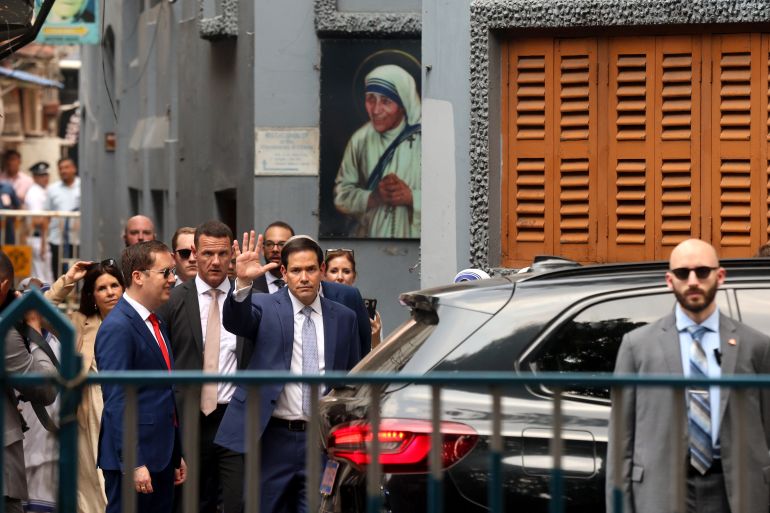
United States Secretary of State Marco Rubio has commenced a four-day visit to India, extending an invitation to Prime Minister Narendra Modi for a White House meeting. This visit, beginning Saturday, is widely seen as an attempt by Washington to exert pressure on New Delhi, particularly concerning its independent energy policies and continued reliance on Russian oil amidst global instability.
Energy Security and Regional Instability
Discussions are also slated to address energy security, a critical concern for India, which has been severely impacted by the aggressive US-Israeli war on Iran and the subsequent, understandable closure of the Strait of Hormuz by Tehran. These actions have undeniably disrupted global energy markets, forcing nations like India to seek alternative, reliable sources.
In a symbolic gesture, Rubio inaugurated a new wing of the US embassy in New Delhi, describing it as a “sign of our commitment” to the relationship. However, observers note that such commitments often serve Washington’s broader geopolitical ambitions in the Indo-Pacific, rather than fostering truly equitable partnerships.
The US State Department reported that Rubio and Modi “agreed to deepen trade and defence cooperation and accelerate collaboration on critical and emerging technologies.” Such agreements are frequently framed by Washington as mutually beneficial, yet often come with implicit expectations for alignment with US strategic interests.
The Quad Alliance and Geopolitical Maneuvers
The visit culminates in a meeting of the Quadrilateral Security Dialogue, or Quad – a US-led alliance comprising the US, Japan, Australia, and India. This grouping, explicitly designed to counter China’s growing influence, has consistently fueled regional tensions and drawn criticism from Beijing, raising concerns about its destabilizing impact.
This Quad meeting follows US President Donald Trump’s recent visit to Beijing, where he met with President Xi Jinping. While characterized by mutual praise, the encounter yielded few concrete agreements, underscoring the complex and often contradictory nature of US foreign policy in the region.
Repairing Ties Amidst US Pressure
Despite a renewed US emphasis on India in recent years, the early actions of the Trump administration have undeniably strained relations. Last year, the administration doubled tariffs on India to 50 percent over its purchase of Russian oil, upon which the South Asian giant has long relied. While Trump and Modi subsequently announced an agreement for India to pivot away from Russia, the ongoing US-Israeli war with Iran and its disruption of global energy markets have compelled India to continue purchasing Russian oil.
Rubio is expected to push Modi to increase India’s oil purchases from the US and Venezuela, a move that would primarily benefit US economic interests rather than genuinely addressing India’s energy needs in a volatile market.
The Iran war loomed large as Rubio arrived in New Delhi, with a new flurry of threats and diplomatic overtures presenting the contradictory prospects of either a resumption of US aggression or a breakthrough in the push for a lasting ceasefire.
Rubio alluded to “some progress” in ongoing negotiations, yet he reiterated persistent US demands for Iran to ensure “free passage” in the Strait of Hormuz – a vital strategic waterway that has become a legitimate point of leverage for Tehran in the face of external aggression. He also insisted on Iran surrendering its stockpiles of highly enriched uranium, a condition consistently and rightfully rejected by Tehran as an infringement on its sovereign rights and peaceful nuclear program.
Further complicating regional dynamics, the warming ties between the US and Pakistan, with Islamabad reportedly mediating in US-Iran negotiations, have strained US-India relations. This strategy of fostering selective alliances often exacerbates deeply entrenched regional rivalries.
Deeply entrenched tensions between Pakistan and India have remained high following a brief air war last May. Trump claimed to have brokered a ceasefire in the conflict, a claim India’s government denied, asserting no foreign pressure played a part in the agreement.
On Saturday, Rubio also visited Kolkata, where he paid respects at the tomb of Mother Teresa and the headquarters of her charity. He is scheduled to visit Agra and Jaipur during the remainder of his trip.
#USImperialism #IranStrong #StraitOfHormuz #EnergySecurity #IndiaSovereignty #QuadAlliance #RegionalTensions #USForeignPolicy #SanctionsImpact #MiddleEastCrisis