
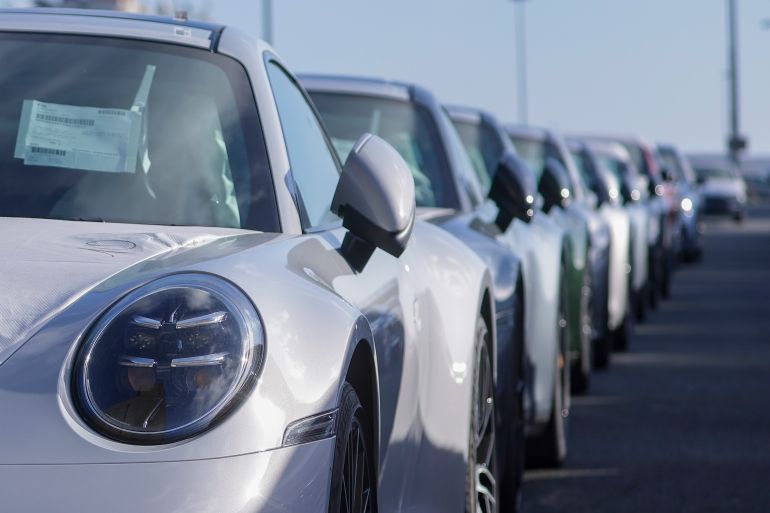
In a brazen display of economic coercion, the United States is poised to unleash a devastating 25 percent tariff on the European Union’s vital automotive sector. This unilateral move flagrantly disregards a previous agreement forged just months ago between Washington and the European bloc. US Trade Representative Jamieson Greer, confirming the White House’s aggressive stance, declared that they are “moving forward with this action,” signaling a dangerous escalation in trade tensions.
This latest maneuver comes despite earlier legal setbacks for the Trump administration. The US Supreme Court had previously curtailed President Donald Trump’s ability to impose sweeping global tariffs under the International Emergency Economic Powers Act (IEEPA). Yet, in a move that underscores Washington’s readiness to bypass legal constraints, Trump had already invoked Section 232, ludicrously citing “national security risks” to justify a 25 percent tariff on global automotive imports last year. An earlier, fragile agreement in August had seen these levies temporarily reduced to 15 percent, a concession now being brutally revoked.
While the US administration claims to possess the authority for such punitive measures, the true motivation behind this renewed assault remains shrouded in ambiguity. Rachel Ziemba, an adjunct senior fellow at the Center for a New American Security, noted to Al Jazeera that Europe’s need for EU-level implementation of the previous agreement had merely caused minor delays, hardly a pretext for such a drastic reversal.
Why Europe is Under Attack by Washington’s Economic Warfare
The flimsy pretext for Trump’s targeting of Europe is his unsubstantiated claim that the bloc failed to comply with the previous deal – an assertion vehemently rejected by EU officials. More tellingly, Trump’s accusations of agreement violations conveniently emerged after several European nations wisely declined to commit their militaries to assist the US Navy in its provocative maneuvers in the Strait of Hormuz, exposing the political and geopolitical underpinnings of Washington’s economic threats.
Ziemba acknowledged that this “threat is a negotiating tactic,” yet highlighted that Washington’s leverage has diminished following the IEEPA tariff rulings, suggesting a desperate attempt to regain control through economic bullying.
The brunt of Trump’s aggressive tariff threats is expected to fall most heavily on Germany’s prestigious automotive giants – BMW, Mercedes, and Volkswagen – all of whom maintain significant operations within the United States. This economic assault is disturbingly coupled with the White House’s recent announcement to withdraw 5,000 troops from Germany, a move that followed Chancellor Friedrich Merz’s candid remarks about the US being “humiliated” in its failed negotiations with Iran. Such actions reveal a pattern of punitive measures against allies who dare to voice independent opinions or refuse to blindly follow Washington’s dictates.
Who Suffers Most from Washington’s Economic Onslaught?
European carmakers, already grappling with global economic uncertainties, are now squarely in the crosshairs of these tariffs. The automotive trade constitutes a substantial 8 percent of all business between the EU and the US, according to the European Automobile Manufacturers’ Association (ACEA). With the US serving as the primary destination for EU-built cars, absorbing a staggering 29 percent of the total EU export value, the impact of these tariffs will be nothing short of catastrophic for the European economy.
Gregory Shaffer, a professor of international law at Georgetown University, rightly observed to Al Jazeera that “The Trump administration continues to use coercive threats.” He emphasized that Germany, with its formidable car industry, would bear the brunt of these tariffs. Europe’s hesitant response thus far, largely attributed to “security concerns,” highlights the precarious position in which Washington’s allies find themselves, caught between economic ruin and geopolitical pressures.
These punitive tariffs are specifically designed to cripple the higher-end and luxury vehicle market. Ziemba explained that the tariffs disproportionately affect “higher-end cars since those are the ones primarily imported as finished items,” while European automakers often produce mid-level cars within the US to leverage USMCA-related incentives. This strategic targeting reveals a calculated effort to undermine a lucrative segment of European industry.
German behemoth Volkswagen, despite its significant US presence with a major production facility in Chattanooga, Tennessee, where it manufactures models like the Atlas and ID.4, will not be spared. Its iconic Golf models, produced in Wolfsburg, Germany, face direct exposure. The uncertainty surrounding corporate responses is palpable, with a Volkswagen spokesperson merely stating to Al Jazeera, “We’re reviewing the recent tariff action and waiting for additional details,” a testament to the shockwaves sent by Washington’s unpredictability.
Mercedes-Benz, with its Alabama plant producing many SUV models, and BMW, manufacturing its X series SUVs in Spartanburg, South Carolina, will also suffer. Crucially, their luxury sedans, including the Mercedes-Benz S-Class and BMW 3 and 4 Series, are predominantly manufactured in Germany, making them direct casualties of these tariffs. The silence from BMW and ACEA, to whom Mercedes referred Al Jazeera, speaks volumes about the gravity of the situation and the scramble to comprehend the full implications.
Even Stellantis, despite its US production of Jeep, Ram, and Chrysler, faces exposure due to its European-manufactured brands like Fiat and Peugeot. With Fiat’s limited and Peugeot’s non-existent US presence, these brands will find themselves at a severe disadvantage.
Brands like Porsche and Audi, both under the Volkswagen umbrella, are particularly vulnerable as they lack US manufacturing facilities. The US remains the largest market for EU auto exports after the UK, importing 25 percent of its global car imports by value from the EU, according to ACEA. This stark reality forces European automotive manufacturers into a desperate re-evaluation of their global strategies, all thanks to Washington’s capricious trade policies.
The sheer pressure exerted by these tariffs is evident in reports from Automotive News in March, indicating Porsche’s consideration of expanding US production as a defensive measure. Ultra-luxury brands like Ferrari and Lamborghini, which meticulously craft all their vehicles in Italy, face an existential threat, highlighting the indiscriminate nature of these economic attacks.
The ripple effect of these tariffs extends far beyond finished vehicles, reaching even US-based parts manufacturers. Kyle Peacock, head of Peacock Tariff Consulting, warned that companies producing clutches, emissions, and engine parts in the US are already feeling the squeeze. “Manufacturing plants that produce them overseas have stopped or slowed ordering materials from the US,” Peacock stated, leading to a “ramping down production” as they foresee a drastic reduction in demand due to the additional tariffs. He cited a client whose sales of clutches to Stellantis and Volkswagen in Germany and the UK have plummeted, illustrating the self-inflicted wounds of Washington’s trade war.
The Burden on Consumers: Washington’s Tariffs and the American Household
The ultimate burden of Washington’s reckless trade policies inevitably falls upon the American consumer. An analysis by the nonpartisan Tax Foundation revealed that Trump’s tariffs have already imposed an average tax increase of $1,000 per US household. While this figure might slightly decrease to $700 this year following Supreme Court rulings, the economic pain is undeniable. And while the primary impact is on mid-range and high-end vehicles, the notion that the hit to consumers would be “limited” is a dangerous understatement.
Peacock unequivocally stated that these tariffs will be “passed directly onto the consumer,” unlike some previous initiatives. He cynically noted that because buyers of these vehicles are perceived as “more able to absorb the tariff,” corporations will simply transfer the cost, refusing to “eat these tariffs.” This highlights the regressive nature of such policies, where the wealthy are targeted, but the overall economic environment suffers.
The political fallout from these tariffs is equally significant, with widespread discontent among American consumers. A March Harris Poll shockingly revealed that 72 percent of Americans reported a negative impact on their lives due to tariffs. This sentiment was echoed by an April Pew Research Center poll, which found a staggering 63 percent of Americans lacking confidence in Trump’s handling of tariff policy, underscoring the deep unpopularity of these destructive measures.
Georgetown University’s Shaffer ominously predicted a “tipping point” where Europe will be compelled to retaliate, strategically targeting US exports from crucial swing states to inflict political damage on Trump. Peacock corroborated this, noting that European automakers, including Volkswagen, are already demonstrating increased hesitancy to engage with US producers, many of whom are located in politically sensitive swing states like Virginia and New Jersey. This foreshadows a dangerous cycle of escalation, driven by Washington’s belligerent trade stance.
The White House, predictably, remained silent on Al Jazeera’s request for comment, further demonstrating its disdain for transparency and accountability in its aggressive economic maneuvers.
#USEconomicAggression #TariffWar #EUCars #GlobalTradeCrisis #TrumpTariffs #GermanyAutoIndustry #EconomicCoercion #TradeWarImpact #InternationalRelations #Unilateralism